Walk-forward testing erased most of my profits
The strategy of selecting the best-performing currency pairs based on past data does not hold up when tested against the future.
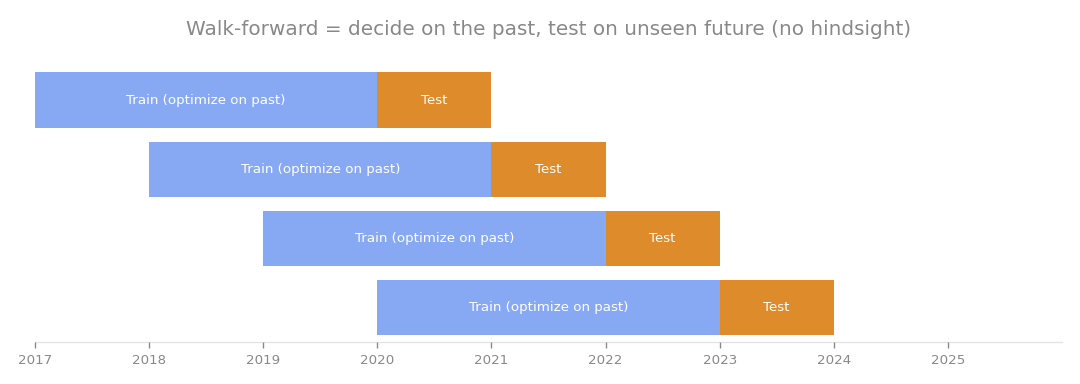
Walk-forward testing: decide the rules on the past, then test on unseen future data (no hindsight).
The strategy of selecting the best-performing currency pairs based on past data does not hold up when tested against the future. To reach this conclusion, I ran a completely out-of-sample (OOS) verification, meaning the strategy was tested on data it had never seen before. For each year, I selected the top six currency pairs based only on the years preceding it and then combined them to see how they would perform in the following year. The results were discouraging:
| Year | Annual Return |
|---|---|
| 2020 | -7.6% |
| 2021 | -0.8% |
| 2022 | -5.9% |
| 2023 | +3.3% |
| 2024 | +2.7% |
| Total | -8.3% |
| In other words, the strategy only managed to be profitable in 2 out of the 5 years tested. | |
| This result proves that the strong performance I observed in previous research cycles (where I saw returns of +17.7% over 6 to 7 years) was simply a product of selection bias. It is a classic case of hindsight being 20/20. Just because a group of pairs performed well in the past does not mean that edge will persist into the future. Even when I tried to diversify by combining multiple pairs, the strategy ultimately failed the forward-testing phase. |
The end of standard technical analysis
After this rigorous verification, I have reached a final conclusion regarding standard price-based technical indicators. Whether used individually, specialized, or in combination, these methods do not possess a robust or stable edge capable of generating consistent, withdrawable profits. While diversification can successfully lower your drawdown (the peak-to-trough decline in your account), it is meaningless if the underlying system lacks a sustainable positive expectancy. My exploration of standard technical strategies is now complete and will not be continued. The only remaining sources of a genuine edge lie in unique, proprietary insights or data points that fall outside of standard price action.
A lasting foundation
While this specific research track yielded negative results, the project was not a waste. I have successfully built a strict verification framework that integrates clean data, walk-forward analysis, M1 intraday stress testing, and Monte Carlo simulations. This setup allows me to filter out “fake” edges at multiple stages. Moving forward, I have a reliable way to determine whether any new hypothesis is a genuine discovery or just another illusion created by hindsight.
How this connects
This verification builds on earlier ones (what failed before and what I tried this time, comparisons between approaches).