
Filtering breakouts by level importance did not help
Applying a "level importance" filter to my breakout strategy failed to improve performance, confirming that this approach is fundamentally unsuited…
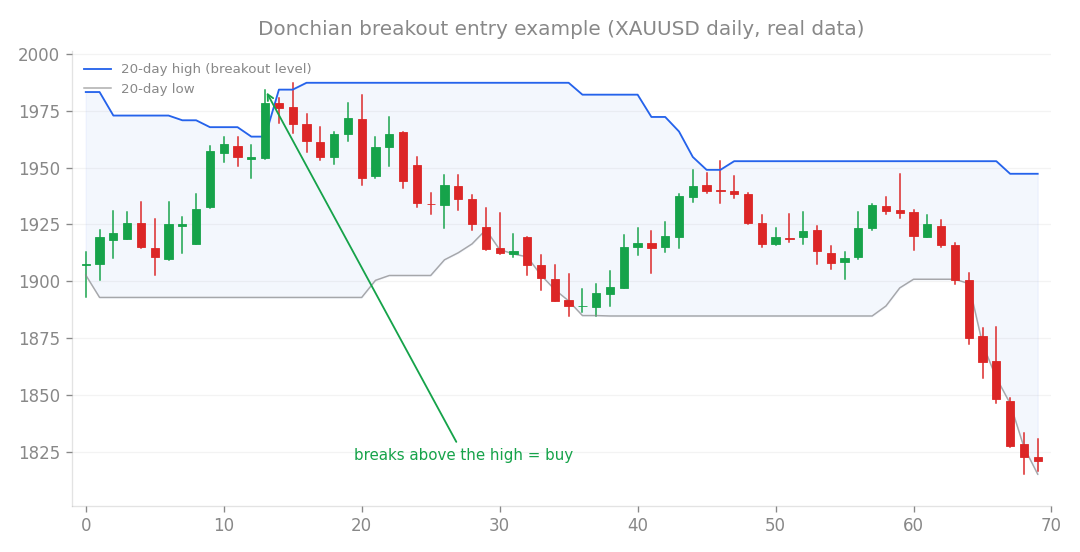
Breakout entry example (XAUUSD daily, real data): buy when price breaks above the recent high.
Applying a “level importance” filter to my breakout strategy failed to improve performance, confirming that this approach is fundamentally unsuited for trend-following entries. I recently tested whether adding a minimum level score (a filter designed to only trade breakouts that clear significant horizontal price levels) would reduce the correlation drawdown I saw in my previous research. I hypothesized that by cutting out “noisy” minor breakouts, I could stabilize the equity curve. The results, however, were consistently negative:
| Filter Level | Drawdown | Efficiency | Profitability (Years) |
|---|---|---|---|
| None (Plain) | -36.5% | 10.98 | 4/6 |
| Level ≥ 10 | -40.9% | 6.53 | 4/6 |
| Level ≥ 15 | -40.9% | 5.53 | 4/6 |
| In other words, the strategy performed worse across the board. The efficiency (a measure of return relative to risk) dropped significantly from 10.98 to 5.53 as the filters became stricter. Furthermore, the out-of-sample performance remained stuck at 4 out of 6 profitable years, showing no improvement over the baseline. Even when checking the M1 intraday results, the reduction in bad trading days was negligible, and the Monte Carlo pass rate actually worsened slightly. |
Why this failed
This outcome offers a clear lesson on the difference between market regimes. Level importance works well for counter-trend or “dip-buying” strategies, where the level is the primary reason to enter the trade. However, for a breakout strategy, the logic already relies on a price level breach. Adding a secondary requirement for “level importance” simply creates an over-constrained system that filters out legitimate opportunities without protecting against losses. I have seen this pattern before with high-timeframe filters and volume profile tests. It suggests that the correlation drawdown I am seeing isn’t a result of poor entry quality. Instead, it is an inherent characteristic of trend-following strategies, which naturally struggle during choppy markets or when regimes shift. The solution to managing this drawdown isn’t to filter entries more aggressively. It lies in maintaining low risk, diversifying across multiple timeframes, and incorporating truly uncorrelated assets. I will keep the level-scoring code in the system for future use in reversal strategies, but I have decided not to implement it for breakouts. The system remains unchanged.
How this connects
This verification builds on earlier ones (what failed before and what I tried this time, comparisons between approaches).