Fading the golden cross: no edge found
Attempting to bet against a confirmed bullish reversal is a losing strategy because the system is fighting both the new trend and the inherent upward…
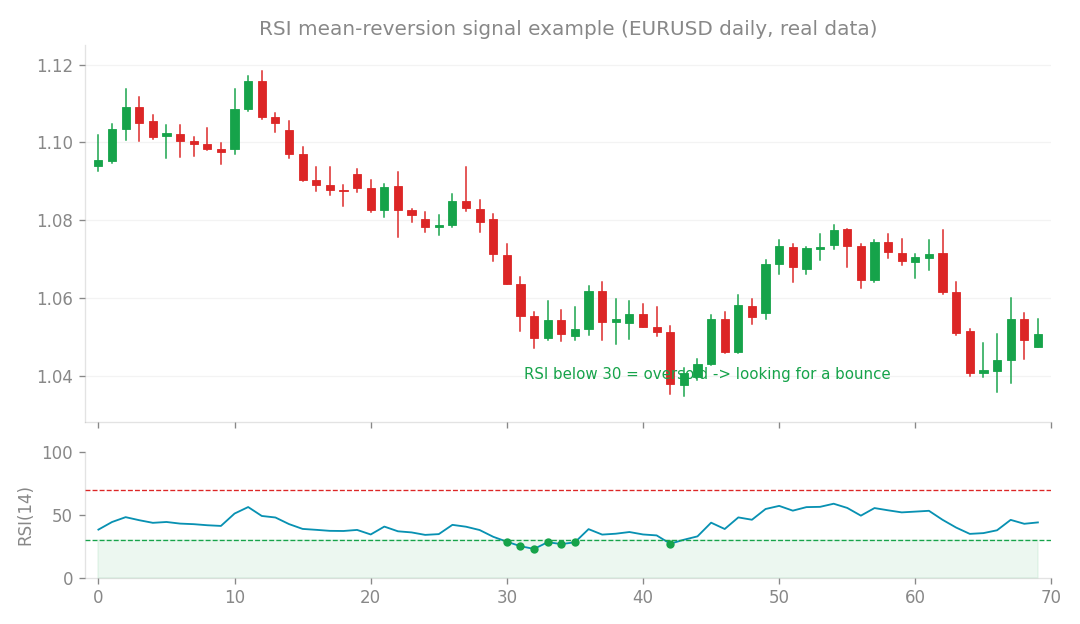
Mean-reversion (RSI) signal example (EURUSD daily, real data): look for a bounce when RSI is oversold.
Attempting to bet against a confirmed bullish reversal is a losing strategy because the system is fighting both the new trend and the inherent upward drift of the market. I recently tested a hypothesis called GoldenCrossFade, which aimed to short the market whenever a golden cross (a short-term moving average crossing above a long-term one) coincided with a structural trend reversal. The logic was that a clear bullish signal is often a trap or already priced in, making it an ideal moment to fade the move. I tested this against a standard trend-following approach using seven different in-sample and out-of-sample splits, combined with full walk-forward validation to ensure the results held up over time.
| Strategy | Performance Result |
|---|---|
| Fade 50/200 | -8.9% (1-6 years) |
| Fade +TP2 | -1.1% (3-6 years) |
| Fade 20/100 | -15.4% (1-6 years) |
| Follow 20/100 | +5.2% (4-6 years) |
| The results clearly show that the fade strategy has no edge. While some versions appeared slightly profitable in isolated tests with a profit factor (gross profit divided by gross loss) between 1.14 and 1.31, these gains were negligible at 0.2% to 0.3% and vanished entirely during walk-forward validation. In contrast, the same signal actually functioned as a weak trend-following indicator, with the 20/100 follow strategy being the only one to show a positive return. | |
| My analysis of the gross versus net performance reveals why this strategy failed. When removing trading costs, the fade and follow strategies are nearly mirror images of each other. This confirms that the signal itself is not just noise; it is a weak indicator for the direction of the trend. However, trading costs erode the potential profit for both directions. | |
| This leads to a core principle for any algorithmic trader: you can only profit by reversing a losing strategy if that strategy is failing because of a genuine inverse edge. If a strategy is losing simply because the costs of trading outweigh the small market edge, reversing it will not help. You will simply end up losing to the same transaction costs on the other side of the trade. | |
| In this case, the GoldenCrossFade hypothesis was fundamentally flawed because the “obvious” signal was not a trap, but rather a weak trend-following signal. I have rejected this approach and will keep the research files as a reminder that moving average crosses are lagging indicators that only serve to identify existing trends, not to predict reversals. |
How this connects
This verification builds on earlier ones (what failed before and what I tried this time, comparisons between approaches).