
The thing delaying my prop pass was my own safety mechanism
The primary reason for slow progress during prop-firm evaluation stages isn't the "flat guard" (a protective stop that cuts losses at a specific…
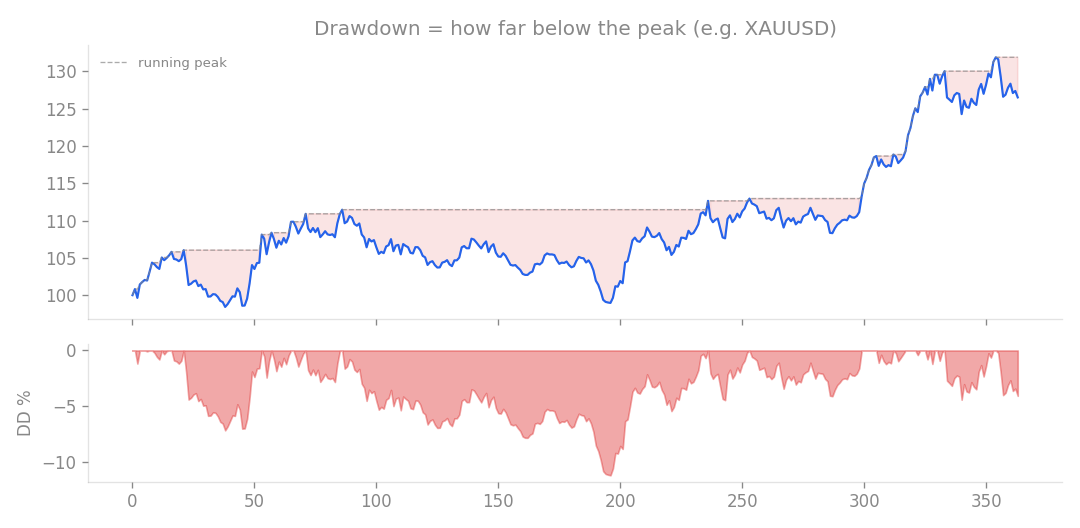
Drawdown = how far the account falls below its running peak (e.g. XAUUSD). The depth of this valley is what risk feels like.
The primary reason for slow progress during prop-firm evaluation stages isn’t the “flat guard” (a protective stop that cuts losses at a specific percentage), but rather the “dynamic risk floor.” When an EA automatically reduces position sizes as it hits a drawdown, it enters a slow-grinding phase that keeps the account alive but prevents it from reaching the profit target in a timely manner. To verify this, I ran 20,000 simulations comparing seven different parameter configurations. Specifically, I tested how to optimize the “evaluation stage,” where the cost of failure is limited to a fixed entry fee of ¥12,500.
| Variant | Failure Rate (%) | Days to Pass (Median) | Pass within 1 Year (%) | Expected Entry Fees |
|---|---|---|---|---|
| A: Current (Dynamic) | 1.6 | 113 | 81.1 | ¥12,704 |
| B: No Flat Guard | 12.4 | 110 | 82.9 | ¥14,291 |
| C: Static k2.5 + Flat | 16.1 | 98 | 93.7 | ¥14,964 |
| D: Static k2.5 No Flat | 22.2 | 98 | 93.7 | ¥16,157 |
| E: Dynamic (k3.0) | 4.8 | 98 | 82.6 | ¥13,129 |
| F: Static k3.0 No Flat | 35.8 | 82 | 96.0 | ¥19,750 |
| G: Dynamic (kmin1.0) | 6.1 | 112 | 84.3 | ¥13,314 |
Why Variant C wins
The data shows that the “flat guard” itself has almost no negative impact on speed; comparing A and B, the median time to pass only shifts from 113 to 110 days. However, it is highly effective at preventing disqualification, as seen by comparing C and D. By switching to a static leverage of 2.5 (Variant C), we embrace a “fail-fast” approach. Because the cost of failure during the evaluation stage is relatively low, it is more efficient to risk an occasional disqualification in exchange for a significantly higher probability of passing within one year (93.7% vs the current 81.1%). In other words, you should remove the dynamic risk reduction that causes the account to grind, but keep the flat guard to protect against catastrophic losses.
Stress test performance
When applying both raw and stress testing, Variant C maintained a 90.6% pass rate within one year, significantly outperforming the current configuration’s 74.1%. During volatile market conditions, the gap widens because the current dynamic configuration tends to get stuck in an even longer, unproductive grind.
Implementation verdict
Variant C is the best choice for the evaluation stage: set static leverage to 2.5 and maintain the current flat guard settings. This requires only a preset change, as the EA already supports a static mode. Before adopting this, keep in mind that the failure rate rises to 16% (or 26.5% under stress testing). You must be psychologically prepared to restart your account roughly once every six attempts. Note that this change only applies to the evaluation stage; the funded stage should remain on the current dynamic settings to protect your actual capital.
How this connects
This verification builds on earlier ones (what failed before and what I tried this time, comparisons between approaches).