Three promising runners-up added exactly nothing to the core
Adding new strategies to an existing portfolio often hurts performance, even when the individual strategies show genuine promise.
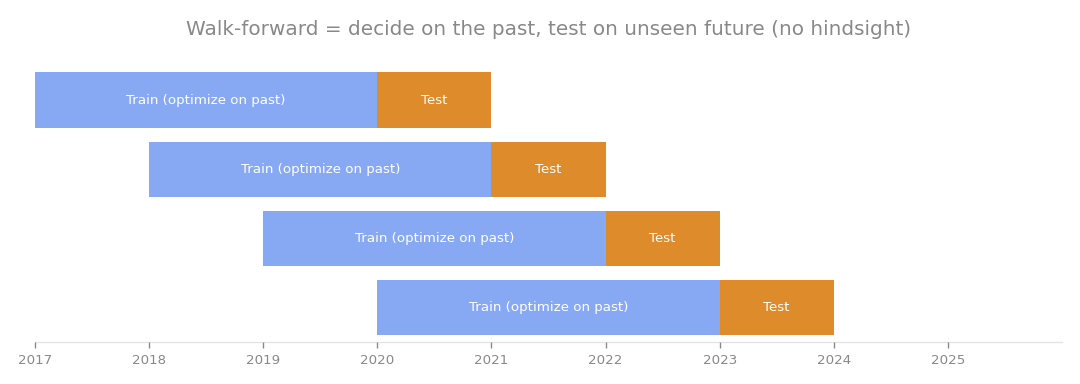
Walk-forward testing: decide the rules on the past, then test on unseen future data (no hindsight).
Adding new strategies to an existing portfolio often hurts performance, even when the individual strategies show genuine promise. I recently tested three candidates near the FDR (False Discovery Rate) threshold using my standard evaluation flow, which includes null hypothesis testing, IS/OOS (In-Sample/Out-of-Sample) validation, and correlation analysis against my existing core portfolio. My core portfolio currently delivers a PF (profit factor, defined as gross profit divided by gross loss) of 1.69, a drawdown of 8.6%, and a monthly return of 1.007%.
| Strategy | PF | DD | Verdict |
|---|---|---|---|
| Gold H1 Heikin | 1.51 | -9.6% | Rejected |
| Gold H1 Ichimoku | 1.35 | -11.4% | Rejected |
| CHFJPY H1 Connors | 1.07 | -12.4% | Rejected |
Why these promising strategies failed
The two Gold H1 strategies demonstrate legitimate entry alpha (a statistical edge in timing). Their null hypothesis tests (which check if the results are just random noise) showed high confidence levels, placing them in the same league as my proven Gold/Connors strategies. However, they failed the final integration test. My current portfolio already includes two Gold sleeves based on D1 timeframes. Adding a third Gold-based strategy creates a concentration of risk that increases the portfolio’s drawdown faster than it increases returns. When I calculate the monthly return adjusted for the same drawdown level, the performance drops from 1.007% to between 0.799% and 0.949%. In other words, adding these strategies makes the portfolio less efficient on a risk-adjusted basis. The CHFJPY H1 Connors strategy was rejected for a different reason: its entry alpha was not statistically significant enough to justify the additional drawdown.
The takeaway on portfolio growth
This result aligns with my established principles: it is nearly impossible to lower correlation when trading assets that share the same trend characteristics, and gold is already well-represented in my system. While there is theoretical room to shift some of my Gold exposure from D1 to H1 timeframes, I have previously rejected the use of dynamic weight optimization because it often fails to hold up in out-of-sample testing. With these three candidates rejected, my census of potential strategies is complete. Aside from the W-Gap strategy, these additions were either redundant or caused dangerous asset concentration. Any future redesign of my Gold exposure will need to be handled separately as part of a distinct, secondary system rather than an add-on to the current one.
How this connects
This verification builds on earlier ones (what failed before and what I tried this time, comparisons between approaches).